Lucknow Emerges as Strategic Die-Sourcing Hub for the MP-UP-Gujarat EV Manufacturing Corridor
Lucknow is emerging as a key die-sourcing hub for the MP-UP-Gujarat EV corridor, leveraging policy support, central location, and the Oct 2026 India Die & Mould Show to serve surging EV tooling demand.
 Admin
📅 June 15, 2026
⏱️ 8 min read
💬 0
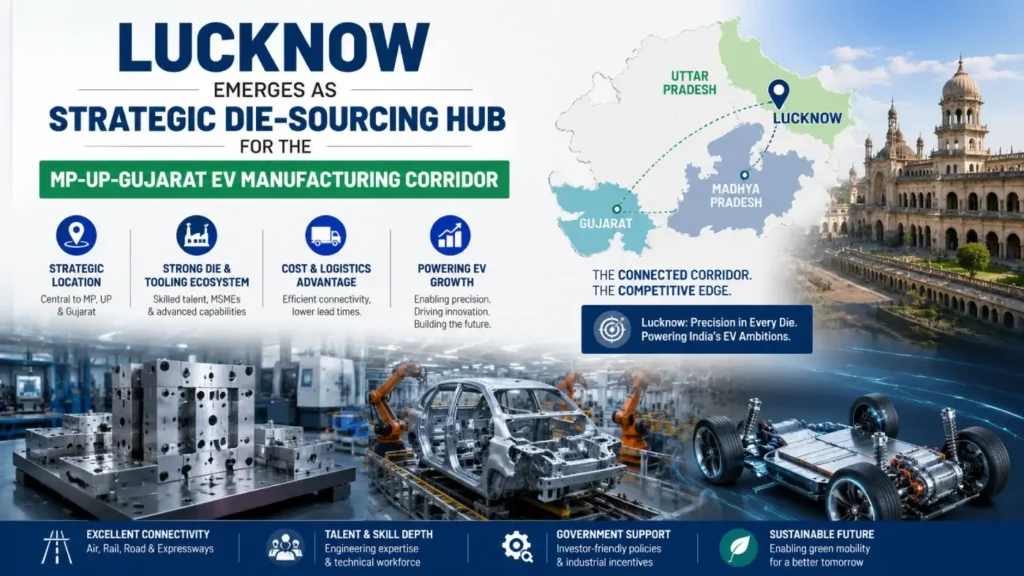
LUCKNOW, June 15, 2026 – As India’s electric vehicle (EV) ambitions accelerate, a new manufacturing geography is taking shape across Central and Western India. The MP-UP-Gujarat EV manufacturing corridor – a loosely defined but increasingly integrated industrial belt spanning three states – is emerging as a powerhouse for EV production. At its heart, strategically positioned for supply logistics and enjoying renewed policy focus, Lucknow is rapidly establishing itself as a pivotal hub for sourcing dies, moulds, and precision tooling.
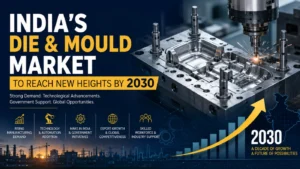
The city, long known more for its cultural heritage than industrial prowess, is being recognized for its unique position to serve the growing tooling needs of EV and auto component manufacturers across this corridor. This development comes at a critical time, as the India dies and molds market is forecast to increase by US$ 2.84 billion during 2024–2029, accelerating at a CAGR of 11.4%. The market is also projected to achieve 10.4% year-on-year growth in 2025–26. While traditional tooling hubs like Pune, Chennai, and Mumbai have long dominated, Lucknow is now being positioned as a complementary strategic sourcing base, leveraging UP’s policy push, improving infrastructure, and rising domestic demand for precision tooling.
The Corridor Takes Shape: A New Geography for EV Manufacturing
The MP-UP-Gujarat EV corridor is not a formally notified industrial zone but a rapidly coalescing belt of manufacturing investments. The Yamuna Expressway (Uttar Pradesh) is becoming a hub for EV manufacturing investments, while in Gujarat, the Sanand–Becharaji corridor is similarly evolving into an EV-focused industrial cluster. A 2026 report further highlights the Sanand–Ahmedabad–Halol belt in Gujarat as an emerging EV hub, home to Tata Motors’ EV plant, Ather Energy, and battery manufacturers.
Madhya Pradesh, as the central link in this corridor, is also actively positioning itself. The state is leveraging the Pithampur auto cluster — spread over 500 hectares and employing over 25,000 people — as the heart of its EV ambition. Together, Maharashtra, Uttar Pradesh, Rajasthan, Gujarat, and Madhya Pradesh are expected to account for more than 70% of India’s charging demand for e-trucks by 2030, according to an August 2025 study by the International Council on Clean Transportation (ICCT). This shared trajectory is creating a massive downstream demand for dies and moulds.
Within this corridor, Lucknow’s central location offers a distinct logistical edge. As the city emerges as a key regional supply chain hub for North India, it serves as a natural distribution point for the NCR’s manufacturing output heading east and as a receiving and redistribution point for imports routed through. A Lucknow-based die-maker can now ship high-precision tooling to Sanand or the Yamuna Expressway belt within competitive timelines, offering a viable alternative to the traditional southern and western clusters.
Gujarat: The Anchor of the Western EV Ecosystem
The corridor’s western anchor, Gujarat, is witnessing unprecedented investment. The Sanand–Dholera corridor has become a focal point for EV and semiconductor manufacturing. Over ₹40,000 crore has been invested in Dholera and Sanand. Tata Group is building a 20 GW lithium-ion battery gigafactory in Sanand and has announced a semiconductor fabrication plant in Dholera. This has spurred heavy demand for industrial tooling. At Tata’s Sanand facility, new dies for stamping critical skin panels have been introduced, alongside modifications for additional robots in the weld shop.
Suzuki has committed 150 billion yen (approximately ₹10,440 crore) to Gujarat for local manufacturing of BEVs and BEV batteries, aiming to boost output from 7.5 lakh to 10 lakh units annually. The Gujarat government is also developing Sanand and MBSIR (North Gujarat Special Economic Region) as dedicated EV hubs, offering priority land allocation and special incentives.
Uttar Pradesh: Policy Push to Attract Ancillary Investment
Uttar Pradesh, the eastern anchor of the corridor, has rolled out aggressive policies to capitalize on the EV transition. The Uttar Pradesh Electric Vehicle Manufacturing & Mobility Policy, 2022 has laid a strong foundation through incentives for EV buyers, manufacturers, and charging infrastructure providers. In a decisive move to promote local manufacturing, from October 14, 2025, to October 13, 2027, a 100% rebate is being given on EVs manufactured, sold, and registered in the state.
The state has also taken direct steps to build the EV ecosystem. In 2025, the Uttar Pradesh government cleared a ₹50 crore EV subsidy scheme to make electric vehicles more affordable. In 2026, it planned to deploy 110 electric buses in the initial phase to improve connectivity to Noida International Airport at Jewar.
Specific to the die and mould sector, a government-run tool room in Lucknow, equipped with advanced machinery including CNC milling, CNC EDM (Electrical Discharge Machining), and wire-cut machines, has long provided the foundational infrastructure for precision manufacturing in the region. This government support is critical, as the cost of a single large injection mold for an EV component can run into ₹2 crore or more, making capital subsidies and infrastructure access crucial for MSMEs.
Industry on the Ground: A nascent but capable supply base
A survey of the commercial landscape in Lucknow and surrounding regions reveals a functioning, specialized supply chain capable of meeting the EV industry’s demands:
- Aglow Engineers Pvt. Ltd. (Noida) is a provider of precision mold and die-making, specializing in insert molding and complex plastic component production for the automotive sector.
- Arihant Dies & Moulds Pvt. Ltd. (Ghaziabad) specializes in the design, development, and manufacturing of plastic injection moulds for automobile, white goods, electrical, and electronics industries.
- Shiva Tech Engineering is a manufacturer of die moulds and patterns, including components for engine blocks and transmission housings.
- Riddhi Techauto Industries Pvt. Ltd. is an IATF and ISO 9001 certified supplier for high precision aluminum die casting and machined parts to the automobile and white goods industry.
The sector received a major vote of confidence with the announcement of a ₹700 million advanced manufacturing hub in the YEIDA region of Uttar Pradesh. The facility, set to focus on rotational moulding solutions for the automotive sector, is being funded in part through foreign direct investment.
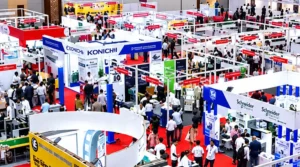
The India Die & Mould Show, scheduled for 8–10 October 2026 at Indira Gandhi Pratishthan, Lucknow, will provide a platform to connect over 500+ global and domestic exhibitors with buyers from the automotive and EV sectors across the MP-UP-Gujarat belt. The show is co-located with the Machine Tools & Cutting Fair, both organized by Future Market Events. Lucknow’s existing industrial profile, including major auto component manufacturers such as Tata Auto Comp, Bosch, RACL Geartech, and Minda Industries, underscores the city’s established manufacturing base.
The Future: From Sourcing Hub to Manufacturing Powerhouse
While Lucknow’s current strength lies in sourcing and ancillary supply, the city’s strategic importance is poised to deepen. A new EV bus manufacturing plant in Lucknow, with an investment of approximately ₹252 crore, marks a significant step toward original equipment manufacturing (OEM) assembly in the state. The union government’s push to increase the outlay for the Electronics Components Manufacturing Scheme from ₹22,919 crore to ₹40,000 crore, underpinning the localization of EV-era inputs, will further benefit the ecosystem that Lucknow is part of.
The upgraded industrial smart cities approved by the Union Cabinet with an investment of ₹28,602 crore will see focused development in sectors such as EVs and Electronics System Design & Manufacturing in Agra and Prayagraj, bringing more EV investment closer to Lucknow.
“The die and mould industry is the silent enabler of the EV revolution. Without precision tooling, you cannot mass-produce battery casings, lightweight body panels, or intricate powertrain components. We are seeing a clear shift where buyers from Gujarat and Maharashtra are now actively scouting for suppliers in Uttar Pradesh,” said an industry analyst tracking the capital goods sector.
As October’s India Die & Mould Show approaches, Lucknow’s position as a strategic die-sourcing hub is no longer speculative—it is a direct response to the geographic and economic realities of India’s unfolding EV manufacturing corridor. For manufacturers in the MP-UP-Gujarat belt, the shortest route to precision tooling may increasingly lead through the city of Lucknow.

Related Articles