
India’s Die & Mould Market Production Crosses ₹18,400 Crore in FY25; Sector Poised for Record Growth
India’s die and mould production crossed ₹18,400 crore in FY25, reflecting 12% year-on-year growth and setting the stage for a record expansion toward a projected $7.5 billion market by 2030, driven by surging demand from automotive, EV, electronics, packaging, and defence sectors alongside supportive PLI schemes and a government push for import substitution.
 Admin
📅 June 3, 2026
⏱️ 18 min read
💬 0
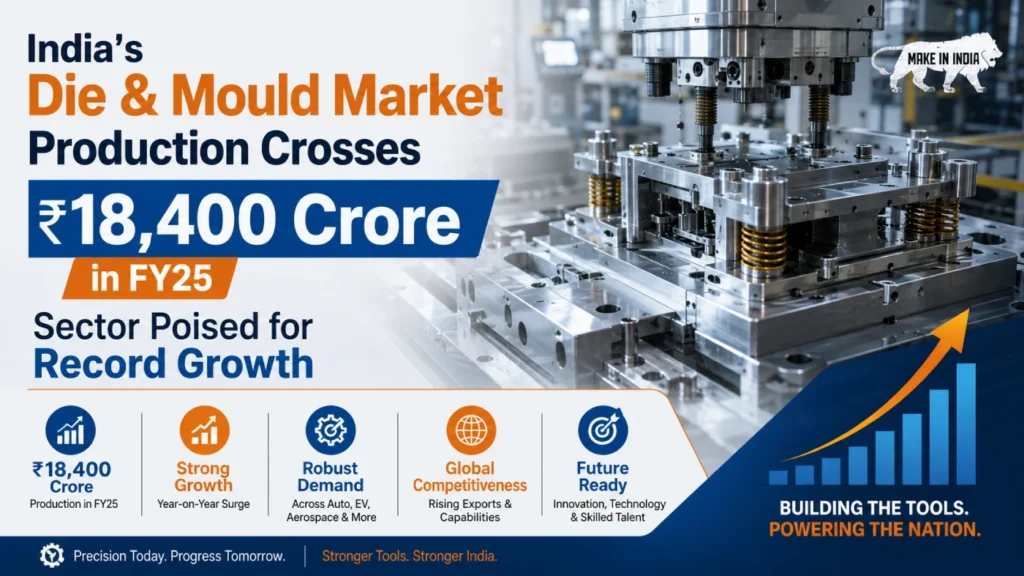
NEW DELHI / LUCKNOW, June 3, 2026 – India’s die and mould sector has achieved a historic production milestone, with output of dies, moulds and press tools reaching an estimated ₹18,400 crore in Financial Year 2024-25, according to official data released by the Ministry of Heavy Industries.
This represents a sharp acceleration from ₹15,600 crore in FY24, underscoring the sector’s rapidly expanding role in India’s manufacturing landscape. The five-year growth trajectory has been consistently upward: from ₹12,294 crore in FY21 to ₹13,128 crore in FY22, ₹13,915 crore in FY23, and ₹15,600 crore in FY24, before the significant jump to an estimated ₹18,400 crore in FY25.
The capital goods sector as a whole has nearly doubled in a decade, rising from ₹2,29,533 crore in 2014-15 to ₹4,29,001 crore in 2023-24, with estimated production in FY25 at even higher levels. The sector now contributes approximately 1.9 per cent of India’s GDP.
Automotive Demand Drives Explosive Growth
The automotive components industry, the largest consumer of dies and moulds, recorded a turnover of approximately ₹6.7 lakh crore (US80billion)incalendaryear2025, marking nearly10percent year−on−yeargrowth. Exports reachednearly US80 billion) incalendar year 2025, marking nearly 10percentyear on yeargrowth. Exports reached nearly US 23 billion, underscoring the growing competitiveness of Indian suppliers in global markets.
In the first half of FY26 (April–September 2025), the auto component industry grew 6.8 per cent year-on-year to ₹3.56 lakh crore, according to the Automotive Component Manufacturers Association of India (ACMA) Industry Performance Review. Electric vehicle (EV) components accounted for 4.6 per cent of total OEM supplies, highlighting the gradual transition toward new mobility technologies within the domestic ecosystem.
The aftermarket emerged as the fastest-growing domestic segment, with revenues rising 9 per cent year-on-year to ₹53,160 crore in H1 FY26, supported by a growing number of vehicles on the road and increasing formalisation of the repair and maintenance ecosystem. Exports grew 13 per cent year-on-year to ₹1.05 lakh crore during the same period, achieved despite supply-chain disruptions and raw material cost pressures.
“H1 FY26 performance reflects the underlying strength of India’s automotive ecosystem, with growth across OEM supplies and the aftermarket,” said Vinnie Mehta, Director General of ACMA.
Market Outlook: US$ 3.20 Billion Growth Opportunity
The India dies and molds market is forecast to increase by US$ 3.20 billion between 2025 and 2030, accelerating at a Compound Annual Growth Rate (CAGR) of 11.6 per cent, according to a Technavio market research report for 2026-2030. The market is also projected to achieve 10.4 per cent year-on-year growth in 2025-26.
The broader India tooling market reached US20.1billionin2025 andisexpectedtoreach US20.1billionin2025 andisexpectedtoreach US 37.7 billion by 2034, exhibiting a CAGR of 7.20 per cent during 2026-2034, according to IMARC Group.
The precision tooling sector alone is projected to reach nearly ₹183 billion by 2030, implying growth of more than 8 per cent annually. Demand is led by industries where accuracy is critical, including automotive systems, electronics, aerospace and medical devices.
According to Technavio, the casting segment was valued at US$ 1.59 billion in 2024, while the automotive segment accounted for the largest market revenue share. Key growth drivers include new opportunities with aluminum metal injection molding and automation in the die casting process.
Government Flagship Schemes Accelerate Domestic Manufacturing
National Manufacturing Mission (NMM)
The Union Budget 2025-26 introduced the National Manufacturing Mission (NMM) with an initial outlay of ₹100 crore, representing the foundational policy blueprint for accelerating India’s industrial growth over the next decade. The mission has set ambitious targets to double the manufacturing sector’s contribution to GDP to 25 per cent by 2035 from 12.9 per cent, while generating 143 million jobs, according to the Economic Survey.
The NMM aims to boost merchandise exports to US$ 1.2 trillion by deepening integration into global value chains. As of August 2025, the mission had successfully onboarded over 500 small and medium manufacturers (MSMEs) and start-ups. It is expected to provide jobs for 22 lakh persons and generate a turnover of ₹4 lakh crore.
The mission adopts a two-pronged approach, with sector-specific interventions across 20-30 prioritised industrial clusters. Sectors are classified into three archetypes: scale (automotive and pharmaceuticals) for rapid expansion; fix and transform (electronics and capital goods) for structural reform; and seed (semiconductors and electric vehicles) for strategic, innovation-led growth.
PLI Auto Scheme: On Track to Exceed ₹42,500 Crore Investment Target
The Production-Linked Incentive (PLI) scheme for the automobile sector is on track to exceed its investment target of ₹42,500 crore, with manufacturers already committing over ₹35,000 crore. Of the 82 applicants under the scheme, which include vehicle manufacturers and auto component makers, 72 have already committed investments. Eighteen companies have met the prescribed thresholds for investment and domestic value addition (DVA).
“This year has been a success for the auto PLI scheme. In just two out of the five years since its launch, a large portion of the committed investment has already been made. From the investment perspective, the scheme has performed very well, with MSMEs emerging as the biggest beneficiaries,” a senior government official said.
The scheme utilised 98 per cent of its allocated budget for the year, with around ₹2,000 crore disbursed out of a total outlay of ₹2,091 crore. Beneficiaries included Tata Motors, Bajaj Auto, Mahindra & Mahindra, TVS Motor, Toyota and Ola Electric.
Cumulative investment under the PLI Auto scheme as of December 2025 reached ₹35,657 crore, with determined sales of ₹32,879 crore and employment generation of 48,974 jobs. The scheme has also catalysed production of nearly 14 lakh electric vehicles since its launch.
The Budget 2026-27 has earmarked ₹5,939.87 crore for the PLI Scheme for Automobiles and Auto Components, marking a substantial increase.
National Capital Goods Policy 2016 Targets Revisited
The National Capital Goods Policy has targeted increasing the share of capital goods in total manufacturing activity from 12 per cent to 20 per cent by 2025, with domestic production share in India’s capital goods demand rising from 60 per cent to 80 per cent by 2025. The policy also aimed to increase exports from 27 per cent to 40 per cent of production, making India a net exporter of capital goods.
Scheme for Enhancement of Competitiveness in Capital Goods Sector – Phase II
The Ministry of Heavy Industries has sanctioned 29 projects under Phase II of this scheme, with a total project cost of ₹891.37 crore and budgetary support of ₹714.64 crore, as part of a broader outlay of ₹1,207 crore.
The approved projects span:
- Centres of Excellence (CoEs) at premier institutions including IIT Roorkee, IIT Delhi, IISc Bengaluru, and IIT BHU in Uttar Pradesh
- Common Engineering Facility Centres (CEFCs) at IISc Bengaluru, ARAI Pune, and BHEL Tiruchirappalli
- Testing and Certification Centres across Maharashtra, Karnataka, Punjab, Kerala, Madhya Pradesh and Telangana
- Industry Accelerators at IISc Bengaluru, IIT Madras, IIT Roorkee, and Indian School of Business
- Qualification Packages for skill level 6 and above through sector skill councils
Quality Control Orders (QCOs) Expand to 769 Products
The Bureau of Indian Standards (BIS) has notified 187 Quality Control Orders covering 769 products as of March 2025, ensuring domestic and imported goods meet minimum safety, quality, and performance standards.
Recent QCO developments include:
- Hand Tools Quality Control Order 2025 coming into force on 1 October 2026 for general manufacturers, with extended timelines for small enterprises (1 January 2027) and micro enterprises (1 April 2027)
- Furniture Quality Control Order, 2025 effective from 13 February 2026 for medium and large manufacturers
- QCOs for PP (polypropylene) enforcement date extended to 24 April 2026
- Omnibus Technical Regulation (OTR) for machinery enforcement extended to 1 September 2026
The rapid expansion has outpaced testing capacity, causing BIS inspection delays and import bottlenecks, highlighting the need for a calibrated, predictable approach.
Uttar Pradesh: Fastest-Growing Major Economy
Uttar Pradesh is emerging as a key manufacturing destination, with projected Gross State Domestic Product (GSDP) of ₹36 lakh crore in 2025-26, growing at 12 per cent, placing it among India’s fastest-growing large economies. The state’s GSDP grew at a CAGR of 10.8 per cent from ₹13.30 lakh crore in 2016-17 to ₹30.25 lakh crore in 2024-25.
Uttar Pradesh Industrial Investment & Employment Promotion Policy
The state offers significant incentives for manufacturing units:
- 100 per cent stamp duty exemption for units in Bundelkhand and Poorvanchal regions
- 75 per cent exemption in Madhyanchal and Paschimanchal (excluding Ghaziabad and Gautam Buddh Nagar)
- 50 per cent exemption in Gautam Buddh Nagar and Ghaziabad districts
- Capital subsidy up to ₹45 crore in Bundelkhand and Poorvanchal
The state’s new solar policy also offers a 100 per cent stamp duty exemption for solar plants and a 100 per cent waiver on electricity charges for 10 years, attracting large-scale investment in renewable energy manufacturing.
Emerging Technologies Reshaping the Sector
Industry sources identify several technology trends driving the die and mould sector:
- Additive Manufacturing (3D Printing): Used for rapid prototyping of moulds, printing conformal cooling channels (reducing cycle time by 20-30 per cent), and producing complex parts directly.
- Aluminum Metal Injection Molding (MIM): The India dies and molds market is experiencing significant growth driven by new opportunities in aluminum metal injection molding.
- Simulation Technology & Digital Twins: Integration of simulation and computer-aided engineering helps optimize mold designs, reduce material waste, and shorten development cycles. For instance, manufacturers can leverage digital twin capabilities to simulate the injection molding process before any physical tool is created.
- Industry 4.0 & Smart Factories: IoT-enabled injection moulding machines, AI-driven quality control, and automation are becoming standard in large tool rooms. The adoption of robotics, CNC machines, and additive manufacturing continues to expand.
- Sustainable Manufacturing: Growing awareness among manufacturers has led to the adoption of environmentally friendly tooling materials and processes, including the use of recycled materials and energy-efficient machining techniques.
MSME Clusters Drive the Industry
The die and mould industry in India is predominantly composed of small and medium enterprises clustered in key manufacturing hubs:
- Pune-Chakan (Maharashtra): Powerhouse for automotive stamping dies and large injection moulds
- Chennai-Bangalore Corridor: Specialized high-tech tool rooms for precision auto components, electronics, and medical devices
- Delhi-NCR: Major hub for auto die-casting and plastic injection moulding
The broader Indian tooling industry is estimated at ₹39,000 crore, with about 70 per cent of this demand met domestically and the rest by imports.
What’s Next: India Die & Mould Show 2026
The pilot edition of the India Die & Mould Show will be held from 8–10 October 2026 at Indira Gandhi Pratishthan, Lucknow, organized by Future Market Events. The show is co-located with the Machine Tools & Cutting Fair.
With the die and mould market crossing ₹18,400 crore in production and projected to add US$ 3.20 billion in value by 2030 at a CAGR of 11.6 per cent, the event aims to bring together tool makers, automakers, and policymakers to showcase domestic capabilities, reduce import dependency, and drive the next phase of growth under the ‘Make in India’ initiative.
