The Backbone of ‘Make in India’: Why the Die & Mould Sector is Crucial for Auto Growth
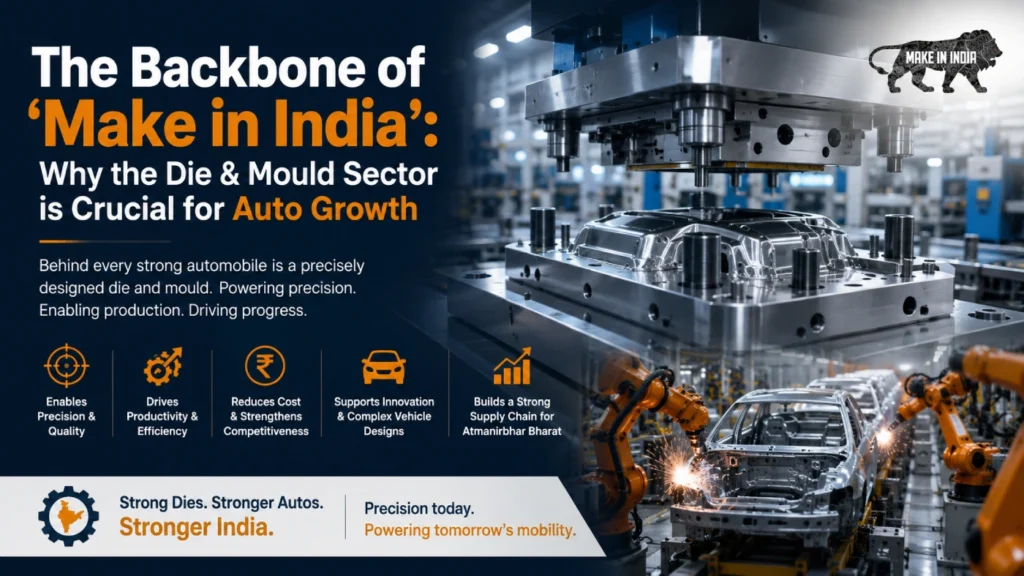
The die and mould sector forms the essential foundation of India’s automotive manufacturing, as every pressed body panel, injection-moulded interior part, engine casting, and EV battery housing depends on precision tooling—making a world-class, local tooling industry critical for achieving true manufacturing self-reliance, reducing costly imports, lowering vehicle development timelines, and supporting the auto industry’s shift toward electric mobility under the Make in India vision.
 Admin
📅 June 4, 2026
⏱️ 10 min read
💬 0
NEW DELHI / LUCKNOW, June 4, 2026 – As India moves towards its goal of becoming a US$ 5 trillion economy, the die and mould sector is quietly but crucially supporting the nation’s automotive success.
The India Die & Mould Show is set for 8 to 10 October 2026 at Indira Gandhi Pratishthan in Lucknow. Industry experts and policymakers are focusing on this sector, which makes possible every car body, dashboard, engine component, and battery casing.
45% of All Die & Mould Demand Comes from Auto Sector
According to the Tool and Gauge Manufacturers Association of India (TAGMA), the domestic die and mould market was valued at US$ 5.8 billion (around ₹45,000 crore) in 2025. It is growing at a Compound Annual Growth Rate (CAGR) of 9% through 2030. The automotive industry accounts for nearly 45% of the total demand for dies and moulds, making it the biggest consumer in this field.
“A typical passenger car requires between 1,000 and 1,500 large stamping dies for its body panels alone,” said a senior tooling engineer at a leading Pune-based auto manufacturer, speaking on condition of anonymity. “Add to that dozens of large injection moulds for dashboards, bumpers, and under-hood components, and you begin to understand the scale.”
Independent research firm Technavio forecasts that the Indian die and mould market will gain US$ 3.20 billion in incremental value between 2025 and 2030, growing at a CAGR of 11.6%. The market shows that plastic moulds hold 42% of the share, while sheet metal dies follow closely at 37%.
Every New Car Model Requires Entirely New Tooling
Industry insiders highlight an essential economic fact: every new vehicle model or significant redesign needs a complete overhaul of tooling. A dashboard injection mould for a popular car can weigh 20 to 30 tonnes and cost over ₹2 crore. It can produce 500,000 parts while maintaining precise tolerances.
In Financial Year 2025, the Indian auto component industry reported a turnover of ₹6.73 lakh crore (US$ 80.2 billion), with an 8.2% year-on-year growth, according to the Automotive Component Manufacturers Association of India (ACMA). The Society of Indian Automobile Manufacturers (SIAM) noted that total vehicle production surpassed 31 million units in FY25 across all segments.
“Without dies and moulds, there is no production. It is that simple,” said a former president of TAGMA. “The sector is the hidden engine room of ‘Make in India’.”
EV Transition Unlocks New Tooling Markets
The shift towards electric vehicles (EVs) is creating new demands for tooling. Battery casings, motor housings, power electronics enclosures, and structural battery trays need large-scale die-casting solutions with integrated thermal management and safety features.
The India Aluminum Die Casting Market is expected to grow by US$ 10.61 billion by 2029 at a CAGR of 11.1%, largely driven by the need for lightweight materials in electric and hybrid vehicles.
Global trends like giga-casting, which involves creating large sections of a vehicle body as a single piece, are being considered by Indian manufacturers. This process requires die-casting machines with clamping forces of 6,000 to 9,000 tonnes, demanding huge tooling.
Government Steps In: PLI, National Manufacturing Mission, and Quality Control Orders
The central government has introduced a comprehensive plan to strengthen domestic tooling capabilities.
Production-Linked Incentive (PLI) for Auto and Tooling
The Ministry of Heavy Industries has allocated ₹25,938 crore for the PLI Auto Scheme, covering FY22 to FY27.
Reports suggest the government is looking at an additional ₹13,000 crore package to promote local tool and die manufacturing, aiming to reduce import dependency.
National Manufacturing Mission (NMM)
Launched in the Union Budget 2025-26, the NMM aims to help India achieve US$ 1 trillion in manufacturing value by 2028. The mission encourages clean technology manufacturing, which includes EVs, batteries, and solar cells— all of which heavily use precision dies and moulds. An initial budget of ₹100 crore has been set for this mission.
National Capital Goods Policy 2016
Created by the Ministry of Heavy Industries, this policy aims to increase the capital goods sector’s contribution from 12% in 2016 to 20% of total manufacturing activity by 2025. Within this, the ‘Dies, Moulds and Press Tools’ sub-sector produced ₹15,600 crore in FY24, up from ₹13,682 crore in FY20.
Quality Control Orders (QCOs) Expansion
The government has broadened the mandatory Indian standards from 80 items in 2019 to over 750 products by 2026. These QCOs require imported components to meet Bureau of Indian Standards (BIS) specifications, which boosts the demand for high-quality domestic tooling.
The Import Challenge: A ₹18,686 Crore Deficit
Despite progress, India is still a net importer of high-complexity tooling and advanced machines. Data from the Indian Machine Tool Manufacturers’ Association (IMTMA) for FY25 reveals:
Parameter
Machine Tool Imports
Machine Tool Exports
Trade Deficit
Value
₹18,686 crore (US$ 2.23 billion)
₹1,472 crore (US$ 176 million)
₹17,214 crore
India ranks as the 4th largest consumer of machine tools globally. However, over 50% of CNC machines needed for advanced die-making are imported. High-grade die steels, such as D2, SKD11, and H13, along with imported mould bases (P20 and 718 grades), continue to be imported from Japan, Germany, and South Korea.
“We make world-class moulds, but our dependency on imported specialty steel and 5-axis CNC machines remains a structural vulnerability,” a Pune-based tool room owner told this correspondent.
MSME Clusters Drive the Industry
The die and mould industry in India is predominantly composed of small and medium enterprises clustered in three major hubs:
Pune-Chakan (Maharashtra): Powerhouse for automotive stamping dies and large injection moulds. Home to tool rooms supplying Tier-1 auto component makers.
Chennai-Bangalore Corridor: Specialized high-tech tool rooms for electronics, medical devices, and precision auto components.
Delhi-NCR: Major hub for auto die-casting and plastic injection moulding, serving the northern automotive belt.
The India Die & Mould Show in Lucknow is strategically positioned to serve this northern cluster and the emerging industrial corridors of Uttar Pradesh.
Emerging Technologies Reshaping the Sector
Industry sources point to four key technology trends that are reshaping die and mould manufacturing in India:
- Industry 4.0 & Smart Factories: IoT-enabled injection moulding machines, AI-driven quality control, and digital twin simulations are becoming standard in large tool rooms.
- Additive Manufacturing (3D Printing): Used for rapid prototyping of moulds, printing conformal cooling channels (which reduce cycle time by 20-30%), and producing small complex parts directly.
- High-Speed Machining (HSM) & Automation: Adoption of HSM centers, robotic part handling, and automated tool changers is accelerating to reduce labor costs and improve precision.
- Multi-cavity Moulds: Rising demand for high-volume production in automotive and pipe-fitting industries is driving adoption of multi-cavity injection moulds.
Uttar Pradesh’s Push: ‘Make in UP’ and Incentives
The Uttar Pradesh government has introduced substantial incentives for manufacturing units under its industrial policy:
- 100% stamp duty exemption for units set up in Bundelkhand and Poorvanchal regions.
- 75% stamp duty exemption in Madhyanchal and Paschimanchal (excluding Gautam Buddh Nagar & Ghaziabad).
- Interest concessions on loans raised for industrial projects.
UP aims to contribute 10% to India’s GDP by 2026, with a GSDP of ₹29.6 lakh crore in 2024-25. The state government is also expanding common facility centers for MSMEs, providing shared testing labs, machinery, and skill training.
“Lucknow is emerging as a new manufacturing and exhibition hub for northern India,” said an official from the Uttar Pradesh Department of Industrial Development. “Events like the India Die & Mould Show will accelerate this transition.”
What’s Next: India Die & Mould Show 2026
The pilot edition of the India Die & Mould Show will be held from 8–10 October 2026 at Indira Gandhi Pratishthan, Lucknow, organized by Future Market Events. The show is co-located with the Machine Tools & Cutting Fair.
According to the organizers, the event will feature live demonstrations of CNC machining, additive manufacturing, and smart factory solutions. It aims to bring together tool makers, automakers, and policymakers to address the import dependency challenge and showcase domestic capabilities.
“This is India’s most focused platform for the die, mould and tooling ecosystem,” a Future Market Events spokesperson said. “We are bringing innovation, technology, and industry leaders under one roof to strengthen Bharat’s engineering and manufacturing ecosystem.”

Related Articles