
How the UP Defence Industrial Corridor is Creating New Opportunities for Die & Mould Manufacturers
The UPDIC, backed by ₹25,000 crore in investments, is unlocking a $1.2–1.5 billion tooling opportunity as indigenous content mandates push global OEMs to partner with local tool rooms, supported by PLI incentives, a proposed Common Tool Room, and the India Die & Mould Show this October.
 Admin
📅 May 24, 2026
⏱️ 8 min read
💬 0
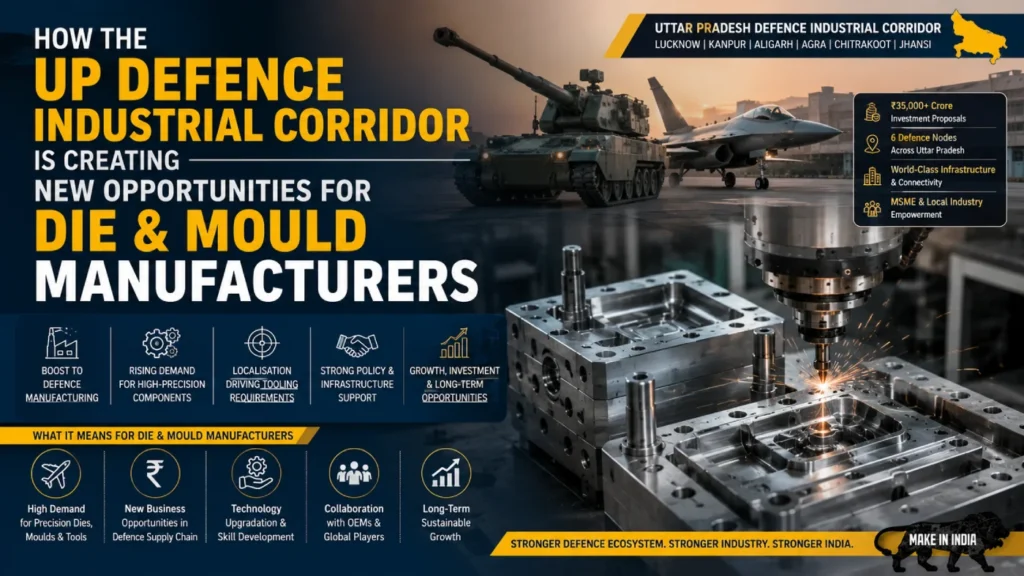
LUCKNOW — India is progressing rapidly towards defence indigenisation, and so the Uttar Pradesh Defence Industrial Corridor (UPDIC) has quickly become more than an area to develop and manufacture weapons platforms and aerospace parts; it is also becoming a major driver of demand for the precision tooling industry across the country. Die and mould makers – the mainstay of producing high-end components – are opening up an entirely new set of opportunities through their use of complex casting dies, composite tooling, electronics packaging moulds, and very high precision press tools.
The defence and aerospace investments in six of the UPDIC nodes, namely Aligarh, Agra, Jhansi, Kanpur, Lucknow, and Bundelkhand Expressway area (Chitrakoot/Banda), are continuing to grow. Projects involving small arms, ammunition, UAVs, electronic warfare systems, and armoured vehicle subassemblies will all be reliant on advancements in tooling processes for the manufacture of components. Typically, the tooling industry has primarily serviced the automotive and consumer goods industries; therefore, the defence corridor provides opportunities for high-value technological work that will substantially raise India’s tooling capability towards global standards.
“Manufacturing defense products is not ever solely assembly based rather it consists of parts that have been manufactured very accurately which have been made by means of die casting or moulding or forging and/or machining to standards that frequently require the use of tools that are 10 times as precise as a tool found in automotive manufacturing. To make/produce each part requires tooling such as Die; Mould; Fixture (Tooling); and UPDI Companies have created a captive market for these tools where there is long-term demand. Tool manufacturers in India will have to take advantage,” said President of TAGMA.
A Corridor Taking Shape: Numbers and Scope
The UPDIC is an existing plan of Government of India formed in 2018 and put into production within the past 3 years. There have been more than ₹25000 crore invested; over 60 MoU’s signed; multiple UPDIC companies in production today – high-profile projects directly related to Tooling.
- Small Arms and Ammunition Plants (Kanpur and Amethi clusters): produce precision forging dies for cartridge cases and other tools used to manufacture small arms such as carbines and assault rifles, injection moulds for polymer components that are used in weapon bodies, and swaging tools to create bullets using rifles. The production of assault rifles and carbines within India is being promoted by the establishment of production facilities through Indo-Russian joint ventures, private Indian companies and supplying partners, which in turn leads to an increase in the demand for high hardness tool steel and complicated die assemblies.
- UAV and Drone Manufacturing (Jhansi and Agra nodes): requires the manufacture of composite moulds and other tooling devices used to create unmanned aerial vehicles (UAVs) and drones. Creating UAVs and drones requires a considerable number of carbon fibre composites throughout the manufacturing process as well as precision plastics manufactured into a high-level quality. To meet the demand for UAV and drone airframes and propulsion systems, a number of start-up companies as well as large aerospace companies are building and supplying UAV and drone airframes and propulsion systems locally.
- Armoured Vehicle Sub-Systems (Aligarh and Chitrakoot nodes): Manufacturing of sub-components to support the production of armoured vehicles in the Aligarh and Chitrakoot nodes requires the capital-intensive use of manufacturing tools (such as heavy press tools, foundry patterns and large scale hot forging dies) which, due to the size and weight of the production tools (which in some cases exceed several tonnes), are considered to represent significant value in a tool room.
- Electronic Warfare and Radar Systems (Lucknow node): Precision electronics housings, connectors, and radomes require high-precision plastic injection moulds and die-casting dies with micron-level tolerances. The presence of systems integrators and defence electronics firms near Lucknow is creating a niche but high-value demand for precision tooling.
According to a senior UPEIDA official, “The tooling prospects in defense are more than merely by volume; they involve value and depth of technology. The worth of an individual mould for a radar antenna housing can be ₹ 1 – 2 crores, with design cycles taking several months. As a result, that kind of work is what turns a job shop into an exact-engineering company.”
The Technology Upgrade Imperative
To capture these opportunities, Indian die and mould manufacturers must upgrade their technology and process maturity. Defence tooling typically demands:
- Ultra-High Hardness Tool Steels: Materials like H13, D2, and advanced maraging steels, capable of withstanding extreme stresses and temperatures during forging and die-casting of defence components.
- 5-Axis High-Speed Machining: Complex contoured surfaces on turbine blades, impellers, and structural components can only be produced efficiently with 5-axis CNC machines.
- Additive Manufacturing for Conformal Cooling: 3D-printed inserts with conformal cooling channels reduce cycle times and improve part quality in injection moulds for defence plastic components.
- Vacuum Heat Treatment and PVD Coatings: Essential for achieving the surface hardness and wear resistance required for high-volume ammunition tooling.
- Metrology and Non-Destructive Testing (NDT): Defence components require 100% inspection with CMMs, laser scanners, and sometimes CT scanning to ensure zero-defect tooling.
The government’s Production-Linked Incentive (PLI) for Defence and Defence Testing Infrastructure Scheme (DTIS) are intended to alleviate the technology gap in the defence sector. The India Die & Mould Show (IDMS) 2026 from 08-10 October at the Indira Gandhi Pratishthan, Lucknow will bring international tooling technology to manufacturers in the corridor.
TAGMA President stated “Lucknow is the nerve centre of UPDIC. With the India Die & Mould Show being here, local tool rooms will have direct access to German, Japanese and Korean machine tooling builders, software providers and suppliers of materials. It can be a one-stop upgrade solution for the defence tooling ecosystem.”
Skilling for Defence Tooling
In addition to tooling requirements, the defence sector also has serious skill shortages. The training needed for programming 5-axis machines, simulating forging die behaviour, designing composite lay-up tools and understanding defence quality (such as AS9100 for aerospace) standards is specialised. The UPDIC has partnered with the Ministry of Skill Development and Entrepreneurship to establish a Centre of Excellence for Precision Manufacturing (CEPM) in Kanpur, with future centres planned for Aligarh and Jhansi.
These centres will train tool designers, CNC programmers, and metrology technicians specifically for defence manufacturing requirements. IDMS 2026 will feature a dedicated Skills Pavilion where these training programmes will be showcased, and youth can interact with industry veterans.
Market Potential: A $1.5 Billion Tooling Opportunity
Industry estimates show that existing defence manufacturing projects under UPDIC could create cumulative tooling requirements of $1.2 billion to $1.5 billion over seven years. This includes both initial investments in production tooling (creates dies and molds, etc.) and ongoing replacement and maintenance tooling. With the current estimated size of the Indian die and mold market at $3.5 billion, there will be significant and high-margin growth opportunities.
Importantly, a large percentage of this tooling demand is currently being met through imports, mainly from Germany, Italy and South Korea (complex dies). With the emphasis on indigenisation (50-60% indigenisation generally required in defence contracts), global OEMs are looking to partner with Indian toolmakers. This partnership will provide a means to absorb technology and build capabilities.
“Global OEMs are now actively searching for Indian tooling partners who have the ability to provide the required quality and delivery times. The UPDIC is about much more than creating manufacturing capabilities — it is also a collaboration platform. Indian toolmakers who invest now in capacity and certification will emerge as the strategic partners to OEMs of the future,” an industry consultant providing advice to a European defence company regarding its entry into India.
The Road Ahead
As UPDIC transitions through the stages of land allocation, MoU signing, factory construction, and serial production, the increased demand for locally sourced, high-precision tooling will also increase for the die and mould industry (MSME’s currently dominate this industry). Therefore, the die and mould industry will need to act quickly to turn their awareness into action by investing in technology, skilling, and quality systems.
The corridor is more than an industrial zone; it is a policy declaration that India will produce its own defence hardware. So, when you look at a piece of artillery, a drone airframe, or an electronic warfare (EW) pod, you will find a die, a mould and a toolmaker behind them. There is tremendous opportunity in the die/mould sector today with the time to act being now; supporting this will be the fact that the entire die/mould industry will meet in Lucknow this October.
